
|
|
| Cliquer ici pour lire l'infolettre en français | View in browser |
 Meet Farmer Erin Durrell from the Cariboo Chilcotin, B.C. Erin Durrell is widely recognized for her involvement in British Columbia’s (B.C.) cattle industry, having served on numerous association and industry boards at the provincial and national level over the years. Taking an active role in shepherding a sustainable future for B.C’s beef cattle industry is a natural fit for Durrell, who owns and operates Narcosli Cattle Company Ltd. with her husband Jeremy Kishkan and family near Quesnel. 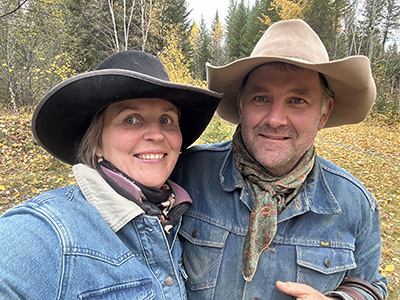 A member of the Esk’etemc First Nation and a fourth-generation descendant of a pioneering Chilcotin ranch family, Durrell has deep roots on both sides of the Cariboo Chilcotin region. Raised along the Chilcotin River west of Williams Lake, she grew up on a large, multi-generational family ranch established by her paternal great-grandfather, Henry (Harry) Durrell, in the late 1800’s. Originally from Ontario, he had travelled west as a young man, working along the way, and eventually settled in the Chilcotin to ranch – and successfully so. The property was designated a Century Ranch in 1995, and his enduring legacy saw the Durrell family inducted into the BC Cowboy Hall of Fame in 2021. The Cariboo Chilcotin is known colloquially as Cowboy Country, in recognition of its rich cattle production and ranching heritage, as well as a sustainable future that ranchers like Durrell and Kishkan commit to by focusing on continuous improvement on their operation. 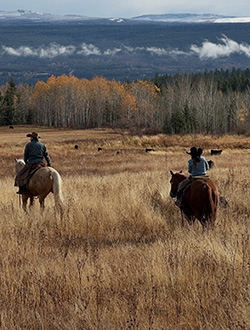 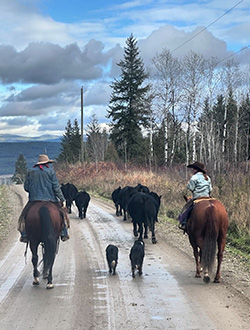 The family runs a black Angus cow herd in the grasslands and bush of the Cariboo region. Much like her forebearers, Durrell and Kishkan have continuously worked to expand and improve their land base, natural resource management and cowherd genetics in the 11 years since they purchased their property and established Narcosli Cattle Co. Their cattle are turned out on a crown range tenure for four months every year under an agreement with the government. The couple is responsible for managing the cow herd while they are on the range – mostly rough country with lots of timber and blowdown, as well as wildlife and challenges – a task usually handled with horses and well-trained stock dogs. The cattle are managed in a way that encourages biodiversity in wildlife and the landscape and helps improve natural grasslands by putting nutrients back into the soil. Maintaining healthy riparian areas and waterways, opening underbrush to support a healthy forest, and mitigating wildfire and invasive plant species are additional beneficial outcomes of managed grazing. “Being able to graze this tenure in a responsible manner is beneficial to us as ranchers and also helps manage the levels of fuels in the forest and mitigate the risk of wildfires as we face ever-worsening fire seasons here in B.C.,” she said. The couple’s commitment to stewardship is rooted in family advice handed down from her paternal grandfather, Jack Durrell, who passed away when she was an infant. “He always said he was just caretaking the land and the ranch for the next generations. My hope is that we can continue his vision for our children and our grandchildren,” said Durrell, who has a daughter, Henri-Rose, and a stepson, Trenton, with Kishkan. The challenge of doing a better job every day to produce high-quality Canadian beef is a great motivator for Durrell. For her, seeing the results of continuous improvement reflected in a consistent calf crop and a great group of mother cows weaning those calves confirms that the family’s efforts are paying off and that they are doing better every year. Her favourite part of ranch life? Being able to raise Henri-Rose in a ranching lifestyle and teaching her about the value of hard work, animal husbandry, environmental stewardship, collaboration, and respect for the land, water and wildlife – all valuable lessons set in motion by Henri-Rose’s great-great-grandfather and namesake, Henry (Harry) Durrell, over a century ago, to help future generations build lasting legacies of their own.  “A cornerstone of our commitment is continually ensuring that all decisions reflect and respect current and future generations,” she said. Durrell's favourite go-to Canadian beef recipe? Anything involving a good steak (especially a rib steak) and a hot cast-iron skillet. "I'm a minimalist when it comes to cooking steak. I season both sides of the steak with salt and pepper, sear it in a hot cast-iron skillet in olive oil until rare, then let it rest briefly before slicing. I serve it with a salad and another side of choice, such as roasted potatoes. Back to main page  GINA TEEL Director, Stakeholder Communications |

|
You’re receiving this newsletter because you’ve subscribed to Canada Beef Performs. No longer interested? Forward to a friend? Editorial contributor and oversight provided by Gina Teel, Director, Stakeholder Communications, Canada Beef. CONTACT US [email protected] canadabeef.ca © 2026 Canada Beef. All rights reserved. 
|

|